AI Agents Are Growing Up
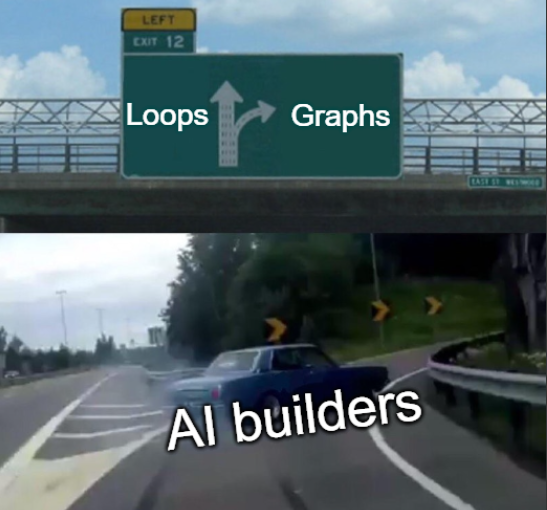
People building AI agents were talking about loops a few weeks ago.
Build a loop -> Evaluate -> Improve -> Repeat.
Now the conversation is shifting. Suddenly, everyone is talking about graphs.
It started with a joke from Peter Steinberger on X:
"Are we still talking loops or did we shift to graphs yet?"
The joke landed because it perfectly captured where AI agent development is today. Loops are not disappearing, they're evolving into something maybe bigger.
That discussion inspired a thoughtful follow-up article by @IntuitMachine, which explores what this shift actually means.
One sentence from the article stood out to me:
"The unit of design is no longer the cycle but the network of cycles."
That line explains the transition better than almost anything else I've read.
A loop is one habit
Think about my SEO agent.
In its simplest form, it might work like this:
- Research keywords
- Write an article
- Evaluate the quality
- Improve the article
- Repeat
That's a loop.
The agent gets a little better every time it goes around the cycle.
For many tasks, that's more than enough.
But real work isn't one cycle
Now imagine you're building an SEO agent for a business.
Before writing anything, it needs to understand the client's goals.
Then it might:
- Audit the website
- Analyze competitors
- Research keywords
- Find technical SEO issues
- Check existing content
- Decide whether a new article is even necessary
If the site has broken internal links, it shouldn't keep writing content.
If the competitors dominate one keyword, it may decide to target another.
If Google Search Console shows pages losing traffic, updating old content may be a better move than creating something new.
Notice what's happening.
The agent isn't simply repeating the same four steps anymore.
It's making decisions.
That's where graphs come in
A graph lets the agent move between specialized tasks instead of following one fixed path.
One part of the system researches.
Another audits.
Another writes.
Another reviews.
Another decides what should happen next.
Each of those parts can still have its own improvement loop.
The graph simply connects them together.
It's less like driving around a roundabout forever and more like navigating a city—you choose different roads depending on where you need to go.
Anatomy of a Graph-Based Agent
To understand why this is a leap forward, it helps to look under the hood. In a graph-based agentic system, the architecture is defined by three core elements:
- Nodes: These are the individual functional units of the agent. A node can be a simple prompt, a tool call (like running a database query), a python script, or another self-contained agent loop.
- Edges: These determine the path between nodes. Edges can be direct (always go from Node A to Node B) or conditional (examine the output of Node A, and decide whether to route to Node B, Node C, or back to Node A).
- State (The Shared Memory): The absolute lifeblood of the graph. Unlike a chat thread that accumulates history linearly, a graph uses a structured state object. Every node can read from and write to this state. This ensures that only relevant context travels across the graph, keeping token usage efficient and preventing the model from getting overwhelmed by noise.
This layout allows us to design architectures like this:
                  +------------------+
                  |  1. Entry Point  |
                  +---------+--------+
                            |
                            v
                  +------------------+
                  |  2. Plan & Audit |
                  +---------+--------+
                            |
                            v
                  +------------------+ <---------------+
                  |  3. Execute Task |                 |
                  +---------+--------+                 |
                            |                          | (If tests fail &
                            v                          |  retries < max)
                  +------------------+                 |
                  |   4. Verify/Test |-----------------+
                  +---------+--------+
                            |
                 (If pass)  |  (If max retries hit)
             +--------------+------------+
             |                           |
             v                           v
     +---------------+           +---------------+
     | 5. Submit PR  |           | 6. Ask Human  |
     +---------------+           +---------------+
Why Graphs Feel Like "Growing Up"
If loops taught agents how to try, graphs teach agents how to handle failure.
In a basic loop, a failure (like a syntax error or a failing test) often leads to a recursive doom-loop: the agent tries the same incorrect fix over and over until it hits a rate limit.
Graphs solve this by introducing explicit routing logic:
- Escalation Paths: If a code generation node fails three times, the graph redirects the workflow to a human reviewer rather than wasting API tokens.
- State Rollbacks: If a code refactoring node breaks the build, the state can be rolled back to the last known good commit before attempting a different path.
- Specialized Agent Gating: Instead of asking a single "generalist" agent to code, review, and test its own work, you can route the code output to a specialized "verifier" agent node that is specifically prompted to find flaws.
Why this matters
The most interesting part isn't that graphs are more advanced.
It's that they resemble how people actually solve problems.
When you're writing an article, you don't always follow the exact same sequence.
Sometimes you stop to research.
Sometimes you realize your outline is wrong.
Sometimes you ask someone for clarification.
Sometimes you throw away half your draft because you found better information.
Human work branches naturally.
AI agents are beginning to do the same.
The Framework Shift
We are already seeing the developer ecosystem evolve to support this. Monolithic agent frameworks that tried to do everything out of the box are losing ground to libraries specifically built for state-machine graphs.
Tools like LangGraph, AutoGen, and custom-built lightweight state routers (often written in pure TypeScript or Rust) are becoming the standard tools of the trade. They don't try to make the model smarter; they make the execution flow deterministic and controllable.
This shift means that developer skillsets are moving from pure prompt writing to system orchestration.
Loops aren't going away
That's probably the biggest misunderstanding.
Graphs don't replace loops.
They organize them.
A graph is really a collection of loops working together, each responsible for one part of the problem while sharing information with the others.
The loop taught AI agents how to improve.
The graph teaches them how to coordinate.
And as AI systems take on larger, messier, real-world tasks, coordination may turn out to be just as important as intelligence itself.