Moving Beyond Prompt Engineering
For the past two years, “prompt engineering” has dominated conversations around AI.
People built courses around it. Job descriptions mentioned it. Teams collected prompt libraries. The core idea was simple: if you could write a better prompt, you could get a better answer.
That still matters, but it is no longer the whole picture.
The next challenge is not writing one perfect prompt.
The next challenge is designing systems where AI can keep working after you stop typing.
That is what I think of as loop engineering.
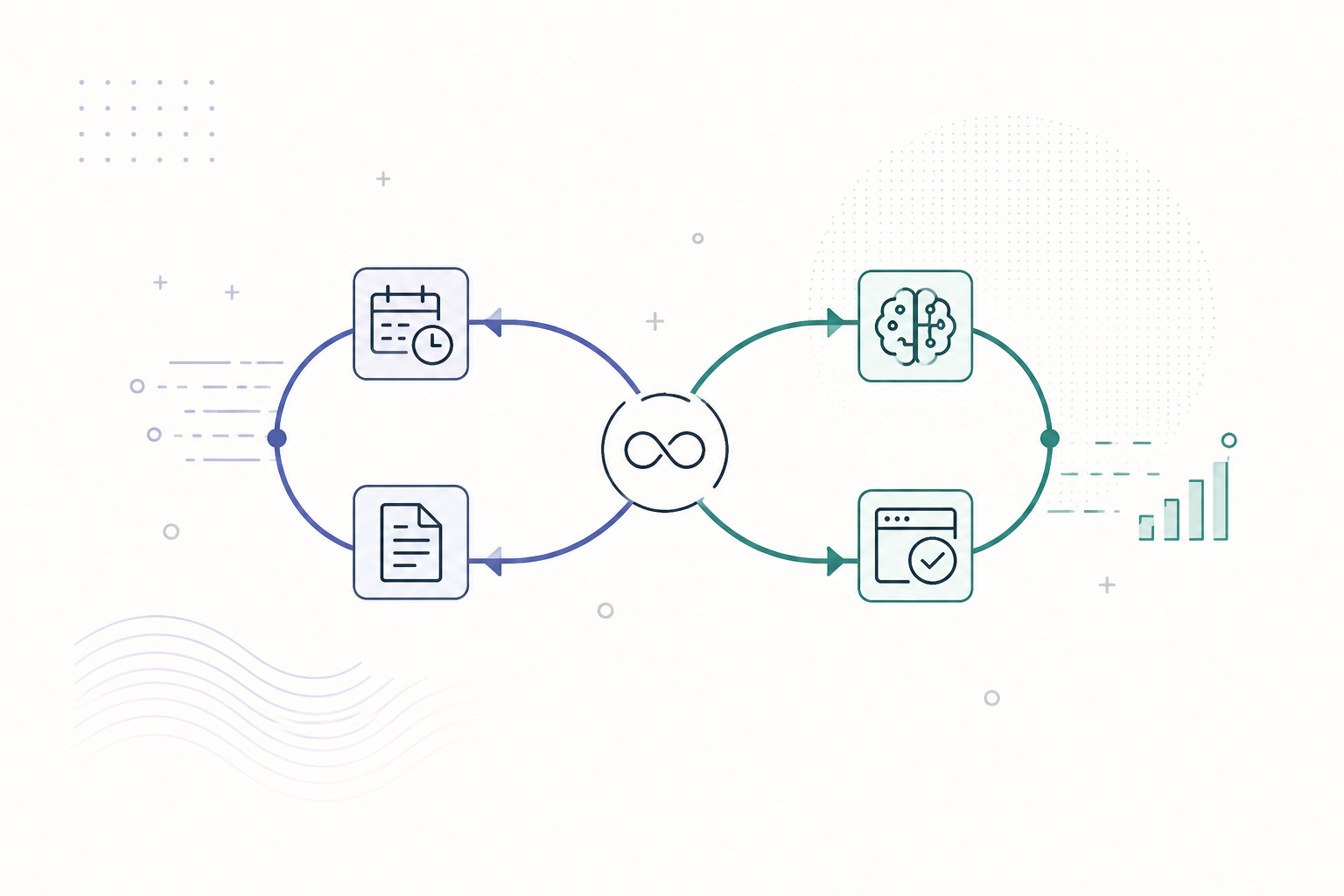
Loop engineering treats AI less like a chat box and more like an operating system for work. The AI does not just answer. It observes, decides, executes, verifies, records evidence, asks for review when needed, and then waits for the next trigger.
The prompt becomes one part of a larger workflow.
The Problem With Prompt Engineering
Traditional AI work usually looks like this:
Human
-> Prompt
-> Model
-> Answer
Every task depends on a human starting it.
Need another task? Write another prompt.
Need to fix something? Write another prompt.
Need more context? Copy and paste everything again.
This works for one-off tasks, but it becomes a bottleneck once AI starts participating in real software, operations, marketing, research, or support workflows.
At that point, the real question changes.
It is no longer:
What prompt should I write? It becomes:
What system should exist so the right work happens at the right time?
What Is Loop Engineering?
Loop engineering is the practice of designing repeatable AI workflows that can run from triggers, use shared context, produce structured outputs, verify themselves, and create useful handoffs.
A simple loop looks like this:
Trigger
-> Read context
-> Plan
-> Execute
-> Verify
-> Save evidence
-> Notify or hand off
-> Wait for next trigger
The human designs the loop.
The AI runs inside it.
This is a very different mental model from prompt engineering. You are not just trying to get a good response. You are building a small production system around the model.
The Building Blocks
A useful AI loop usually needs a few core pieces.
1. Triggers
Every loop needs a reason to wake up.
A trigger might be:
a schedule
a GitHub event
a new Linear issue
a Slack command
a database change
a support ticket
a failed test
a human approval
another agent finishing work
Without triggers, the AI is still waiting for someone to type.
With triggers, the system can start work on its own.
2. Shared Context
Chat history is not enough.
Real agent systems need durable context: client records, repo metadata, issue details, previous run results, accepted rules, rejected ideas, validation history, and operating constraints.
That context should live somewhere structured, not inside someone’s memory or a random Slack thread.
For example, instead of manually telling an agent the same domain, repo, brand voice, internal links, and approval rules every time, those should live in a source-of-truth record that the agent can read before acting.
3. Contracts
Agents need predictable inputs and outputs.
A developer agent should not return a vague paragraph saying “done.” It should return something structured:
{
  "status": "done",
  "linear_issue": "ABC-123",
  "repo": "example/repo",
  "branch": "agent/example-task",
  "pr_url": "https://github.com/example/repo/pull/1",
  "files_changed": ["app/page.tsx"],
  "validation": {
    "status": "passed",
    "commands": ["npm run build"]
  },
  "evidence": {
    "summary": "Build passed and PR opened."
  }
}
Contracts make agents easier to debug, evaluate, retry, and connect to dashboards.
Without contracts, every integration becomes fragile.
4. Verification
This is the piece people often skip.
An AI saying it completed a task is not enough.
The loop should verify the work:
run lint
run tests
run type checks
validate schemas
check generated files
inspect build output
confirm PR creation
record failures
retry simple fixes
Verification is what moves the system from “the model seemed confident” to “the work produced evidence.”
5. Human Review Points
Autonomy does not mean removing humans from the loop.
It means putting humans at the right control points.
Some work can run automatically. Some work should stop for review. Some work should only notify people when action is needed.
A good loop knows the difference between:
safe to run automatically
needs review
failed and needs attention
duplicate or low quality
ready to dispatch
That is how AI systems become useful without becoming noisy.
A Practical Example
One loop I have been working on follows this pattern:
Scheduled trigger
-> Read client/source records
-> Discover topic opportunities
-> Enrich with search data
-> Score and deduplicate ideas
-> Save candidates to a backlog
-> Show them in a review dashboard
-> Human approves one
-> Developer agent implements it
-> Validation runs
-> Pull request is created
-> Evidence is saved
-> Result is evaluated
The important part is not the individual prompt.
The important part is the system around the prompt.
The topic discovery agent does not just invent ideas. It reads client context, uses market/search signals, avoids duplicates, stores evidence, and creates reviewable candidates.
The developer agent does not just write code. It receives a structured task, works in a repo, runs validation, opens a PR, and returns structured evidence.
The dashboard does not just display outputs. It becomes the review layer where people can approve, reject, mark duplicates, retry, and inspect results.
That is loop engineering.
Why This Matters
The bottleneck is shifting.
Models are getting better quickly. The harder problem is coordinating them safely.
A team does not win by having one impressive prompt. It wins by building systems where AI work is:
triggered reliably
grounded in context
bounded by contracts
verified by checks
visible to humans
recorded as evidence
improved through evals
This is closer to software engineering than prompt writing.
You are designing the operating loop around intelligence.
Evals Make The Loop Smarter
Once agents are running repeatedly, the next question is quality.
Which topics were actually good?
Which PRs were clean?
Which failures repeated?
Which outputs should become examples?
This is where evals come in.
A loop should eventually score its own outputs:
business fit
search intent
evidence quality
duplication risk
implementation quality
validation result
scope control
review readiness
At first, these scores can be manual. Over time, they become training data for automated evaluators and gates.
That is how the system improves without relying only on vibes.
The Shift
Prompt engineers optimize conversations.
Loop engineers optimize workflows.
Prompt engineering asks:
How do I get the model to answer this well? Loop engineering asks:
How do I make this work happen reliably every time? That shift changes everything.
The future is not just better prompts. It is better loops: systems where AI can discover work, do work, verify work, remember what happened, and ask for help only when it should.
Prompts are still useful.
But the real leverage is in the loop.